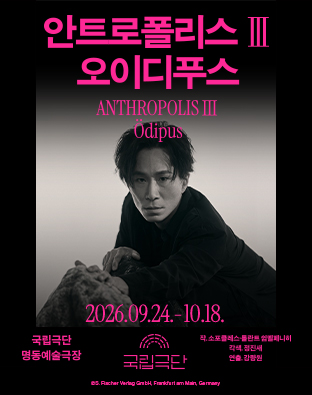
ANTHROPOLIS III Ödipus
24 Sep, 2026~
18 Oct, 2026
The Oedipus we thought we knew is gone.
-
Venue
Myeongdong Theater
-
Genre
Theater
-
Show Time
Weekdays 7:30pmㅣSat & Sun & Public Holidays 3pmㅣNo performance on Tuesday
-
Tickets
R 60,000KRW | S 45,000KRW | A 30,000KRW
-
Duration
120
-
Enquiry
1644-2003
Language Korean
*English subtitles are provided on Thursdays and Sundays. (except 10/4)
Age Restriction Suitable for ages 16 and over
“The road ahead stretches further still.”
Acclaimed by audiences and critics alike,
the epic journey of the Anthropolis pentalogy continues with its third chapter.
★★★★★
ANTHROPOLIS I: Prolog/Dionysos won Best Production, Best Director,
and Best Stage Design at the 62nd Dong-A Theater Awards.
ANTHROPOLIS II: Laios received a nomination for Best Performance in Theater at the 62nd Baeksang Arts Awards.
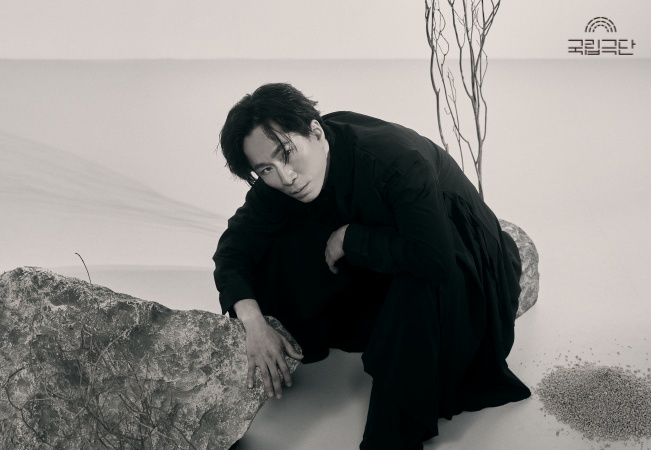
The Anthropolis series, which has left a lasting impression on the contemporary theater scene,
now opens its third chapter, Ödipus.
Exploring urgent contemporary questions of the posthuman, solidarity, and care,
the production reimagines the myth of Oedipus from a new perspective.
It will be followed by Iokaste and Antigone/Epilog, completing the expansive world of the Anthropolis series.
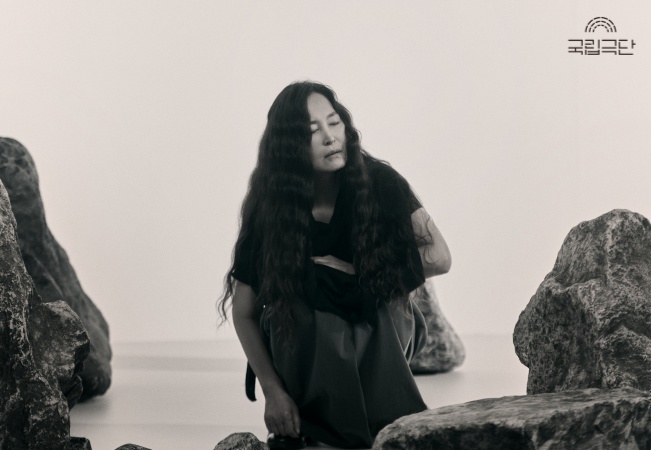
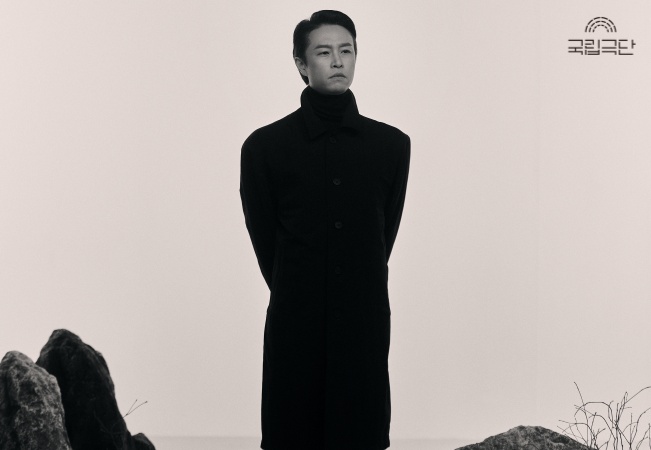
The Oedipus we thought we knew is gone.
Director Kang Lyang-won moves beyond the familiar figure of Oedipus in pursuit of fate and truth,
recasting him instead as someone who questions an anthropocentric view of the world.
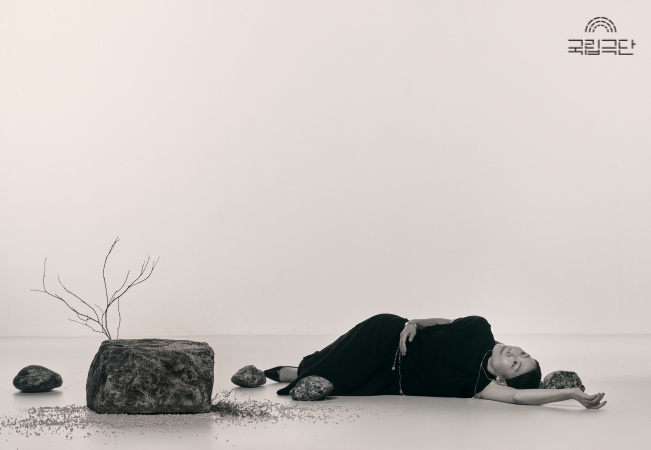
With a faltering body and blind eyes, the tragic hero journeys into the wilderness.
This is no longer a story of victory or salvation.
Rather, it raises a question about a new world in which humans and nonhumans,
the powerful and the vulnerable, might live side by side.
It is a question addressed to all of us living in the world today.
Who do we, as humans, live alongside?
A Creative Team That Brings Contemporary Questions to the Stage
Director Kang Ryang-won, who has steadily expanded his distinctive, experimental theatrical language,
is joined by scenographer Im Il-jin, winner of Best Stage Design at the 61st Dong-A Theater Awards
and the artist behind the visual world of the Anthropolis pentalogy.
Also joining the creative team are costume designer Oh Su-hyun,
whose work brings characters and their stories to life with meticulous detail,
and musician Jung Jae-il, whose scores for Parasite and Squid Game have earned him
worldwide recognition and whose work moves freely across film, theater, and popular music.
Where philosophical inquiry meets remarkable stage aesthetics,
this production reinterprets the ancient Greek tragedy through a contemporary lens,
unravelling in rich theatrical language the questions facing us today.
Synopsis
The city is struck by a disaster. The land dries up, livestock collapse, and children do not survive. The people turn to Oedipus and plead with him to save them. Meanwhile, Creon returns from consulting the oracle with a revelation.Oedipus learns that the blood of Laios, the former king murdered long ago, remains unavenged and that the city can only be restored once the killer is found and punished. He vows before the people that he will find the culprit and sets about solving the crisis. The prophet Tiresias dismisses Oedipus’s efforts and tells him that confronting the truth is the hardest thing of all, before falling silent. When an enraged Oedipus presses him, the prophet finally declares that the man who killed Laios is none other than Oedipus himself. Oedipus takes this as a conspiracy by Creon to seize power and accuses Tiresias of being his accomplice.
However, in conversation with Queen Iokaste, the circumstances of Laios’s death begin to align with his own memory of an old man he killed impulsively long ago. Standing before those who remember the abandoned child and the killing at the three-way crossroads, Oedipus refuses to stop asking questions. As horses, dogs, goats, eagles, and even a diamond appear as witnesses to the events, the non-humans testify to truths that humans have forgotten.
The scattered fragments of the past converge into a single truth, and Oedipus comes to realize that he himself is the source of the calamity.The journey from the homeland that he previously took to escape his fate ultimatelybecomes the very path that fulfills it. At the end of his search for truth, Iokaste takes her own life, and Oedipus blinds himself.
The king who once saved this land is forced to confront the fact hat he himself has become the source of its ruin. Taking young Antigone by the hand, he heads for the wilderness,bearing the full weight of his guilt and the limits of being human.
Written by Roland Schimmelpfennig
Born in Göttingen, Germany, Roland Schimmelpfennig is today one of the country’s leading playwrights. After studying theater directing at the Otto Falckenberg School of the Performing Arts in Munich, he went on to work at some of the most prestigious theaters in the world, including the Kammerspiele in Munich, the Schaubühne in Berlin, the Burgtheater in Vienna, and the Volksbühne in Berlin. His plays are performed extensively around the world, and he has received commissions from major international venues in Vienna, Zurich, Copenhagen, Stockholm, Toronto, Tokyo, and beyond. In 2009, his play The Golden Dragon, which he wrote and directed for its world premiere at the Burgtheater Vienna, received the Mülheim Playwriting Award and drew wide attention. Works introduced to Korean audiences include The Golden Dragon, The Woman Before, and Arabian Night.
<Keine Arbeit für die junge Frau im Fühlingskleid(No Work for the Young Woman in her Autumn Dress)>
<Fisch um Fisch(Fish for Fish)> <Vor langer Zeit im Mai(A Long Time Ago in May)>
<MEZ> <Die arabische Nacht(Arabian Night)> <Push-Up 1-3(Push Up)>
<Vorher/Nachher(Before/After)>, <Die Frau von fruher;(The Woman Before)>
<Calypso>, <Der goldene Drache(The Golden Dragon)>
<Peggy Pickit sieht das Gesicht Gottes(Peggy Pickit sees the Face of God)>
Awards
2024 Stuck des Jahres
2010 Mulheimer Dramatikerpreis
2009, 2002 Nestroy Theatre Prize
1998 Fordergabe des Schiller-Gedachtnispreises von Baden-Wurttemberg
1997, 2010 Else Lasker-Schuler Dramatist Prize
Adapted by Jeong Jin-se
Jeong Jinse is a playwright and director with Theater Moon. Working across a wide range of fields in the performing arts, including playwriting, directing, criticism, and editing, he has developed a distinctive style of his own by combining language-driven original theater with multifarious imagination. His plays often feature science fiction, animals, and children.
Major Works
Camino de Far East Siberia, Actress-1: The Nation's No.1 Robot Actor, Actress-2: A Robot Specializing in Villain Roles, 2021 University Scholastic Ability Test: Integrated Social Search Area, 103 Monologues for the Oppressed Non-Humans, When Your Left Hand Holds My Left Hand and Their Left Hand, The Scene Far from the 20th Century, A Lonely Dog, a Troubled Person, a Sad Cat
Written: Ddansori-pan (original yeonhui theater), Ttamtti Pungnyu (samulnori theater)
Adapted: Hamlet, Crescent Moon, The Song of Sim Cheong
Adapted & Directed: The Tale of Heo Saeng’s Wife (original pansori)
Devised & Directed: History of Slogans 1945-2015, Blood, Sweat, Tears (street theater)
Awards
2026 Seoul Children’s Theater Award, Best Director: The Mad Dog of Flanders
2022 Dong-A Theater Award, Best Play: Camino de Far East Siberia
2021 Red Award, Notable Gaze: A Lonely Dog, a Troubled Person, a Sad Cat
2021 Baeksang Arts Award, Best Young Theater: 2021 University Scholastic Ability Test: Integrated Social Search Area
2010 Seoul International Performing Arts Festival, Young Critics Award: Demain
Directed by Kang Lyang-won
Kang Ryang-won founded Dong Theatre Company in 1999 and has since pursued theatre work characterized by unfamiliar and restrained rhythms of language, fragmentation, and physical movement. He gathers a range of ideas through workshops with actors over a long period of time and then incorporates them into the careful construction of each scene. In 2018, his production of Waning Crescent, or the Way You Remember the World received numerous major theater awards.
Major Works
I Am My Own Wife, Mukti, A Swallow Heart, Corridor Chimney Urn, Macbeth, Heads Wearing Hats with Hieroglyphic Patterns, Across the World to You, A Refugee One Day, When New Leaves Bud, Consent, The Invisible Man, The Noodle House in Sangju
Awards
2025 International Association of Theatre Critics Korea, Top3 Plays of the Year: Mukti
2018 55th Dong-A Theater Awards, Best Production: Waning Crescent, or the Way You Remember the World
2018 International Association of Theatre Critics Korea, Top3 Plays of the Year: Waning Crescent, or the Way You Remember the World
2018 The Korean Theatre Review, Top 7 Productions of the Year: Waning Crescent, or the Way You Remember the World
2016 53rd Dong-A Theater Awards, Best Director and Best Production: Bethany
2016 International Association of Theatre Critics Korea, Top 3 Plays of the Year: Bethany
2016 The Korean Theatre Review, Top 7 Productions of the Year: Bethany
2013 International Association of Theatre Critics Korea, Top 3 Plays of the Year: I Am My Own Wife
2010 International Association of Theatre Critics Korea, Top 3 Plays of the Year: The Inspector-General
2010 The Korean Theatre Review, Top7 Productions of the Year: The Inspector-General
2008 45th Dong-A Theater Awards, New Concept Theatre Award: As I Lay Dying